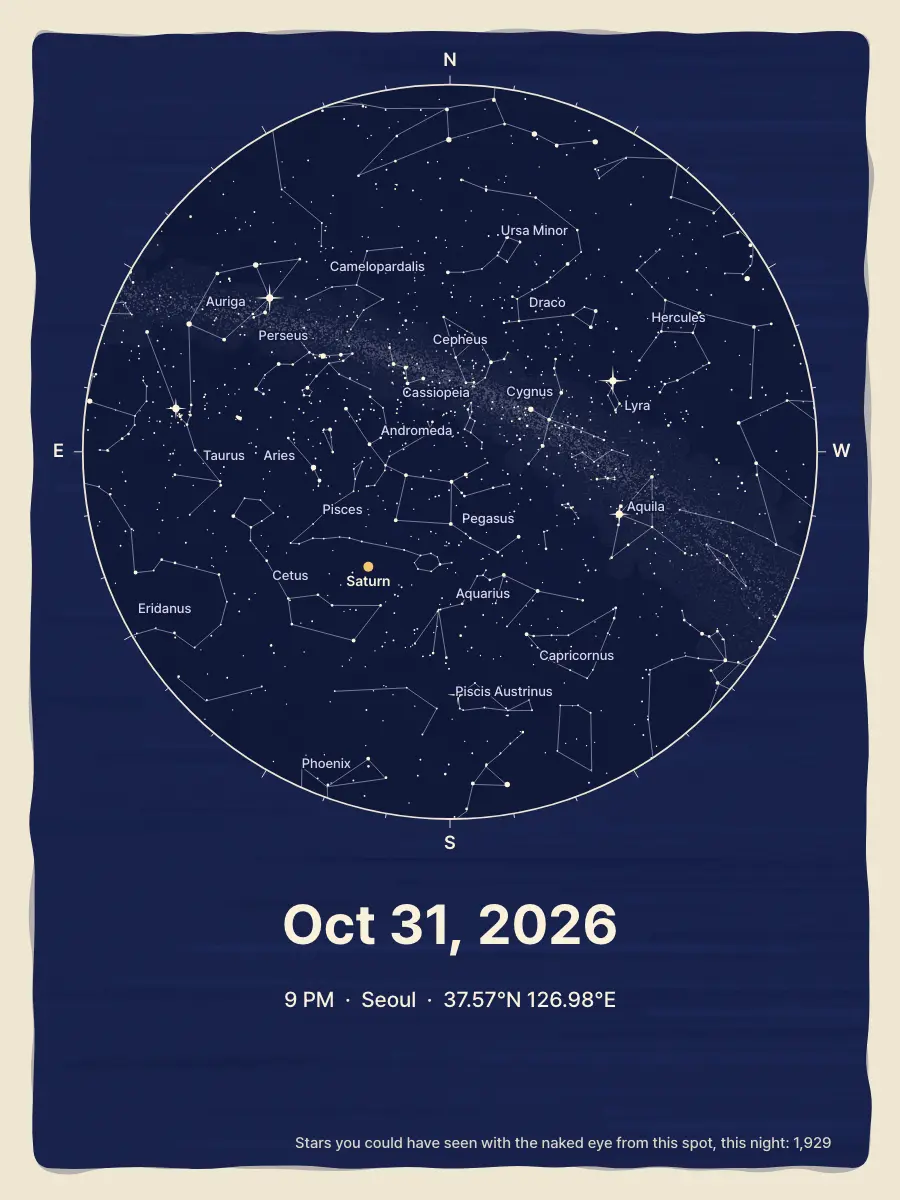
Change the date and place, and it becomes that night's sky, right there
The sky that night
Enter a date and a place. You get the real sky over that spot, as a poster to keep.
Example: Oct 31, 2026
Oct 31, 2026, 9 PM, Seoul · last quarter · 1,929 stars
Constellations up that night
Our night
Stars you could have seen with the naked eye from this spot, this night: 1,929Worked out from moonlight and twilight. Clouds and city lights that night are unknown, so they are left out.
A sky drawn from astronomical calculation. Clouds and city lights are not included.
- Moon
- last quarter, 65% lit, below the horizon
- Planets
- Saturn (naked eye)
- Constellations up
- Andromeda, Cassiopeia, Pegasus, Cygnus, Aries, Cetus, Perseus, Aquila, Taurus, Auriga, Eridanus, Sagittarius, Orion, Cepheus, Pisces, Aquarius, Draco, Lyra, Camelopardalis, Ursa Minor, Capricornus, Piscis Austrinus, Hercules, Corona Borealis, Phoenix, Ophiuchus
- Naked-eye stars
- Stars you could have seen with the naked eye from this spot, this night: 1,929
- Universal time
- 2026-10-31 12:00 UTC (UTC+9)
How it works
How to use it
Pick a date and a place and the poster turns into that sky right away. If you don't know the time, leave it: we draw 9 PM and print no time. Your line is optional. Without one, the date takes its place.
Search any city, or use the map if yours isn't listed. The map is a drawing inside this page, so where you tap goes nowhere.
There are three styles. Picture-book night suits a child's room, ink and paper uses the least ink at home, and starlight gold works as a gift. You can save a 2400×3200 poster, a 1200×2600 phone wallpaper and a 1080×1350 card.
How the sky is worked out
First your local time becomes Universal Time, and this is where most star maps go wrong. 9 PM in Seoul on July 15, 1988 was summer time, UTC+10. Read as plain UTC+9 it would be a different sky, an hour later. So we follow the rules that place actually used on that date.
Then astronomy-engine moves each star to its altitude and direction for that moment, with precession and nutation included. The catalogue is the Yale Bright Star Catalogue: 6,331 stars down to magnitude 6.2, near the naked-eye limit. The poster draws down to 5.5. The Moon shows its true lit fraction with the bright side toward the Sun.
A sky map is the sky seen from below, so with north up, east is on the left. That is the reverse of a street map, and it is correct.
How the stars are counted
The small line in the corner is the number of stars you could have seen with the naked eye from that spot that night. We add up dark-sky brightness, twilight and moonlight at each point of the sky, then work out the faintest star a person could find there, allowing for the extra air near the horizon. That's why Seoul shows 1,999 on a moonless night and 596 under a full Moon.
In daylight the line says 0. Just after sunset it gives no number, because the model is out of its measured range. An honest gap beats an invented figure.
It runs to a single star, but it is model output, not a measurement. Clouds and city lights are unknown, so they are left out. Use it to compare two nights.
Constellation lines and the Milky Way
The IAU fixed 88 constellations and their borders in 1922, but no stick figures are official. The lines are convention. We use the ones from d3-celestial.
The Milky Way band is drawn along the galactic equator: its position is calculated, its width and softness are drawing choices. Star sizes show brightness steps, not real sizes. The paper grain, foil and share art were made with AI, then edited.
Sources and credits
- Stars: Bright Star Catalogue, 5th Revised Ed. (Hoffleit & Warren 1991), CDS V/50, Harvard CfA copy (opens in a new tab)
- Positions and phases: astronomy-engine 2.1.19 (MIT, © Don Cross) (opens in a new tab)
- Constellations: IAU, 88 constellations (opens in a new tab)
- Constellation lines: d3-celestial (BSD-3-Clause, © 2015 Olaf Frohn), after the IAU charts (opens in a new tab)
- Korean names: KASI (53), Korean Wikipedia (35 southern names, secondary) (opens in a new tab)
- Cities: GeoNames (CC BY 4.0) (opens in a new tab)
- Time zones: IANA tz database, from your browser (opens in a new tab)
- Limiting magnitude: Crumey 2014, MNRAS 442, 2600 (opens in a new tab)
- Moonlight: Krisciunas & Schaefer 1991, as written in Yao et al. 2013 (opens in a new tab)
- Twilight: Patat et al. 2006 (measured at Paranal, Chile, so an approximation elsewhere) (opens in a new tab)
- Sunset definition: USNO (opens in a new tab)
- Illustration: AI-generated (Gemini), edited by plusbeauxjours
Questions
- Is it really the sky from that night?
Yes. Stars, Moon phase and planets are calculated for that date, time and place. Moon and planets were checked against NASA JPL Horizons. We can't know whether it was cloudy or how bright the city was, so neither is included.
- What if I don't know the time?
That's fine. Choose "I don't know the time" and we draw the sky at 9 PM and print no time on the poster.
- How do you count the naked-eye stars?
For each star above the horizon we work out the faintest star a person could find against that patch of sky, moonlight and twilight included, and count the star if it is brighter. Seoul on the night of Jan 1, 2000 comes to 1,999. Seoul under the full Moon of Sep 27, 2015 comes to 596. It is a calculation, not a real count.
- What if it happened in the daytime?
The poster says so. With the Sun up, 0 stars could be seen, but they were all still there, so we draw them all. Just after sunset the model is out of its measured range, so we leave the number out.
- What about daylight saving time?
It's handled. Zone history comes from the IANA time zone data in your browser. Before standard time we use the place's own local mean time. If the clocks skipped your time or it happened twice, a note under the time field tells you. US towns before 1967 set summer time locally, so we flag those dates.
- Is it free? Can I print it?
Free. It's a 2400×3200 PNG, about 200 dpi at 30×40 cm. Print at home or at a shop. Print colors vary by paper and printer.
- Where does what I type go?
Nowhere. Date, place and your line are computed on this device and never stored. The poster is drawn here too. City search downloads a list file from this site, which can reveal the first letter you typed and nothing more.
- Is this astrology?
No, it's astronomy. There are no readings here. We don't sell or name stars either, because nobody can.
Sources: Bright Star Catalogue (opens in a new tab) · astronomy-engine (opens in a new tab) · IAU (opens in a new tab) · d3-celestial (opens in a new tab) · KASI (opens in a new tab) · GeoNames (opens in a new tab) · Checked
Last updated